
Autumn trees
Wet-on-wet reds and oranges for the leaves, then dry brown branches painted on top once it has dried.
Game Tailors
Source: Watercolor for kids: wet-on-wet, blooms and salt
The drawing app where the paper is real. No ads, no accounts, no data collected.
Game Tailors · Schieweg 15Y-40, 2627 AN Delft (NL)
KvK 92437702 · VAT NL866044474B01
info@gametailors.com · +31 6 4227 5919
© 2026 Game Tailors
Art technique
Watercolour is paint that travels with water. On wet paper it spreads and blends by itself; on dry paper it keeps a crisp edge. As it dries, colour gathers at the rim, drops of water push it into blooms, and salt leaves little starbursts.

Watercolour is on the drawing bar, free, in nine colours. The paper underneath is simulated in half-millimetre cells, each with its own fibres and wetness, so it behaves like real paper:
Each stroke wets the paper. Colour spreads into wet areas with ragged, fibre-shaped edges, and dries with a darker rim and a faint yellow-brown tide mark.
Wet-on-wet and wet-on-dry. Paint into a wash that is still wet and the colours bleed into each other; paint on dry paper for crisp edges.
Blooms. Water → Drops (Bathroom) on a drying wash push the colour out into a frilly “cauliflower” with a dark rim.
Salt. Sieve → Salt (Kitchen) on wet paint leaves pale starbursts.
Blotting. Press the Paper towel (Bathroom) on a wet wash: it lifts the colour in the towel’s quilted pattern.
Glazing. The same colour again doesn’t turn to mud; a different colour on top mixes.
The paper itself. Wet paper cockles as it dries and never quite flattens. Put in the freezer grows feathery ice-crystal ferns in wet paint, and at the easel soaked paper runs and drips off the bottom edge.
Everything in this list is free.

Wet-on-wet reds and oranges for the leaves, then dry brown branches painted on top once it has dried.
A blue wet-on-wet wash with salt sprinkled in: the starbursts look like falling snow.
Dark blues and purples blended wet-on-wet, salt for stars, and a white crayon planet hidden underneath.
Wet a strip of paper and touch in the rainbow’s colours side by side. Where do they mix?
Blooms, tide lines and salt stars follow the same physics every time, and Undo is one tap. You can freeze a wet painting for ice ferns, or stand it at the easel and watch it drip. Everything here is free.
The paper matters more than the paint: on thin printer paper colour soaks through and the sheet buckles. Real pigments can granulate, settling into the grain of the paper in a speckled way, which the app doesn’t show.
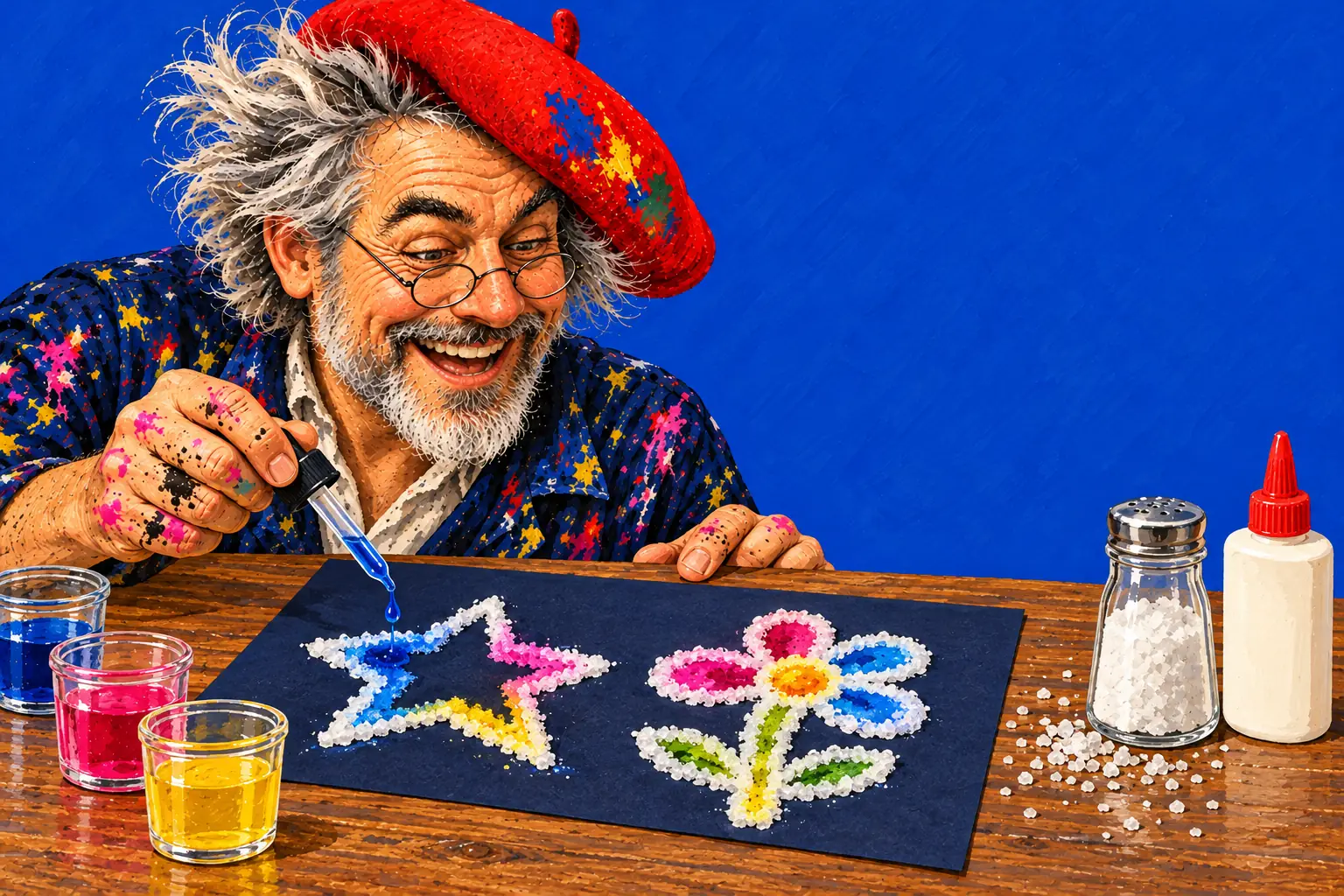
Wet paper is like a sponge: the colour travels wherever the water goes. When a wet patch dries, the water at its edge goes last and carries colour there, so the edge ends up darker.
For grown-ups. Capillary action draws water and pigment along the paper fibres, which is why wet fronts are ragged rather than round. As a wash dries, evaporation is fastest at its edge, so water flows outward to replace it and carries pigment there: the coffee-ring effect, or edge darkening. A drop into a half-dry wash flows out into the damper paint and pushes pigment into a bloom with a hard rim. Salt is hygroscopic and draws water towards each grain, pulling the paint round it into star shapes. Fibres swell when wet and shrink unevenly as they dry, so the sheet cockles.
For teachers
Watercolour fits KS1 and KS2 art (painting techniques with a range of materials) and science about water: absorbency in KS1 everyday materials, and evaporation in KS2 Year 4 states of matter. The paper chromatography experiment shows the same travelling water splitting a colour apart.
Watercolour paper or heavy cartridge paper, about 200 g/m² or more. Printer paper buckles and tears when it gets wet.
Painting onto paper that is already wet, so the colours spread and blend with soft edges. Wet-on-dry, painting onto dry paper, gives crisp edges.
As the paint dries, water flows to the edge, where it evaporates fastest, and takes colour with it. It is called the coffee-ring effect.
Sprinkle table or coarse salt onto paint while it is still shiny-wet, let it dry completely, then brush the salt off.
From about 3 or 4 with a chunky brush and a few colours. Older children enjoy controlling wet-on-wet, blooms and salt.
Glue, salt and colour that races along the line.

A white crayon drawing appears under the paint.
A black marker hides blue, pink and yellow.