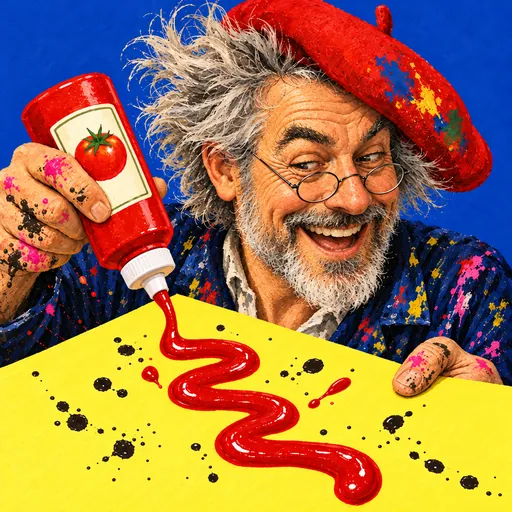
Which helper holds best?
Shake three jars: one with mustard, one with washing-up liquid, one with nothing. Which stays cloudy longest?
Game Tailors
Source: Oil and water experiment for kids: why they don't mix
The drawing app where the paper is real. No ads, no accounts, no data collected.
Game Tailors · Schieweg 15Y-40, 2627 AN Delft (NL)
KvK 92437702 · VAT NL866044474B01
info@gametailors.com · +31 6 4227 5919
© 2026 Game Tailors
Kitchen science experiment
Oil is lighter than water and doesn't mix with it, so it floats on top in a layer. Shake them together and they go cloudy, then separate again. Add egg yolk, mustard or soap and the tiny droplets stay mixed: an emulsion, like mayonnaise.
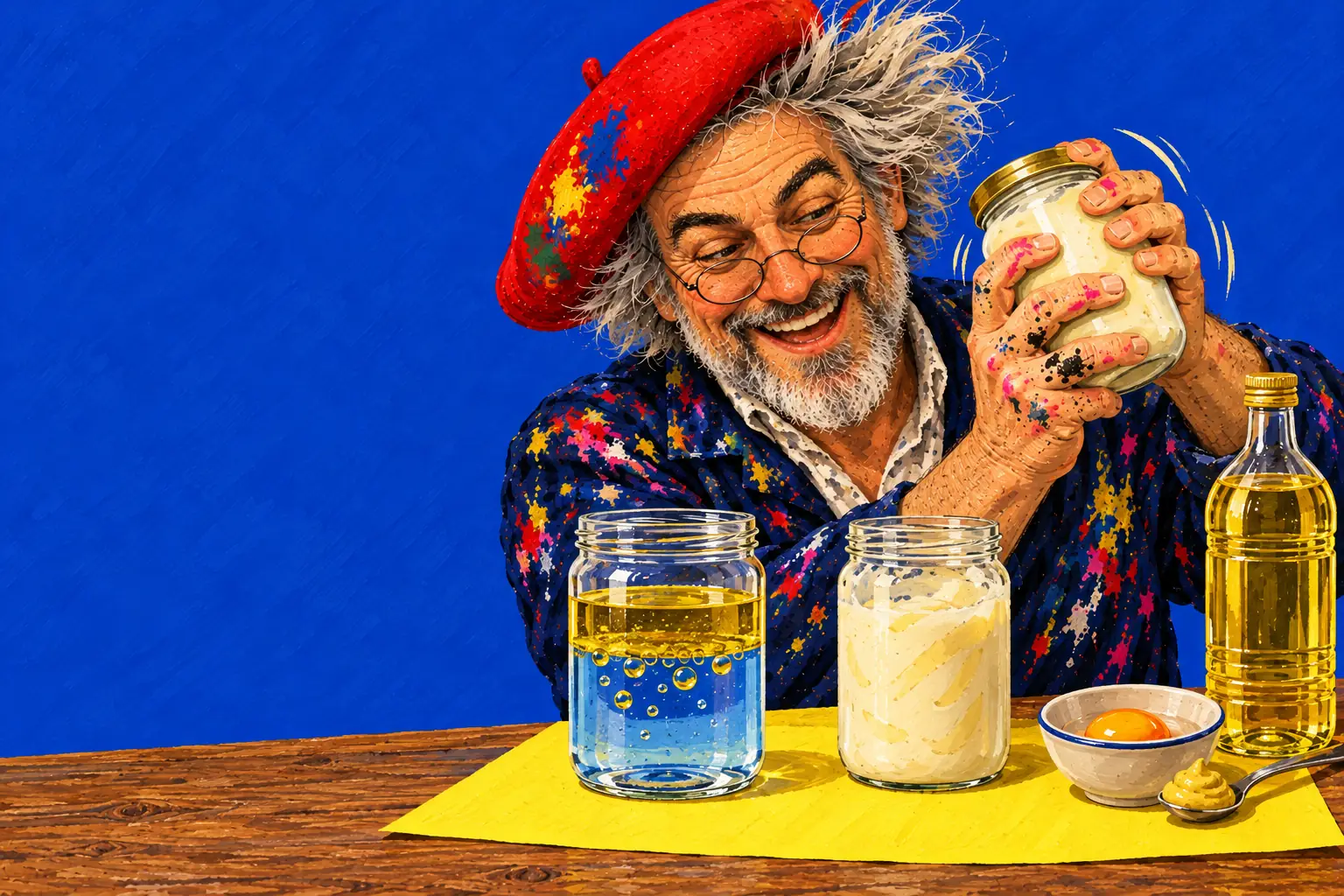
Pick Cooking oil on the Kitchen tab: pour it or let it drip. Pour some water first (Water on the Bathroom tab) and put the oil on it: it floats as a golden, glossy film that spreads out further and thinner on the water than on the paper. Drip water onto oil lying on the paper and the water goes under it, while the oil comes up on top.
Then make it mix:
Vinaigrette. Pour a small puddle of water, drip vinegar into it (Science tab), pour a little oil on top and stir round with your finger (the hand). It goes cloudy, and within a minute or two the oil is a layer again.
Mayonnaise. Crack an egg (Kitchen), pour oil on the yolk and stir. Poured on, the oil just lies there; stirred in, it turns into one pale, creamy mass that holds. Mustard (Squeeze) or a drop of dish soap (Science) holds it too.
Grease stain. Leave oil on bare paper and it soaks in as a darker, see-through stain. Water and the sponge won't shift it; dish soap, water, a rub and the sponge will.
The drying race. Pour two puddles and put oil on one. The bare one dries up; the one under the oil stays wet.
Melted butter and candle wax float on water like oil, and set into a skin as they cool.
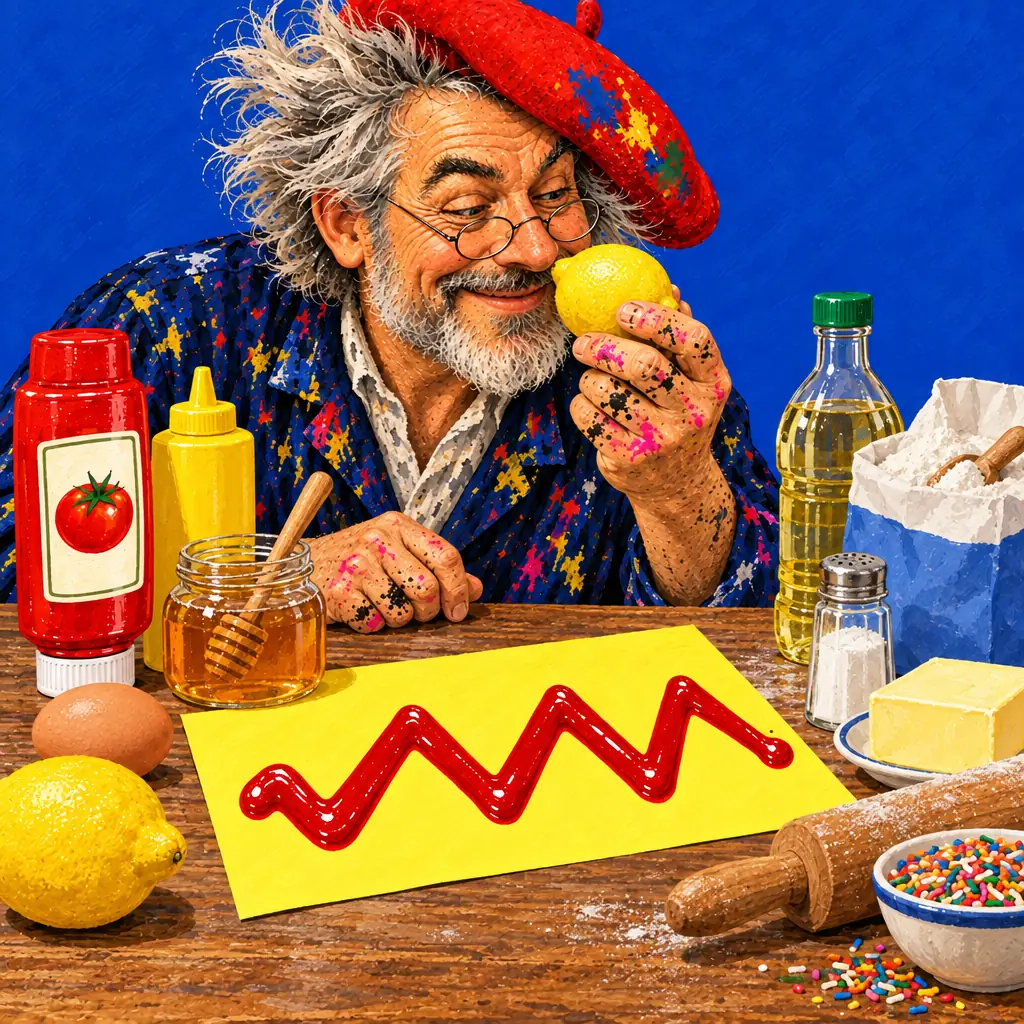
You need
A clear jar with a tight lid
Water, with a drop of food colouring to tint it
3 to 4 tablespoons of cooking oil
1 teaspoon of mustard, or a squirt of washing-up liquid
For mayonnaise: 1 egg yolk (pasteurised if anyone will taste it), a whisk and a bowl
A sheet of kitchen paper or a brown paper bag
Two saucers
Fill the jar a third full with tinted water, then pour in the oil. Where does the oil go?
Screw the lid on tight and shake for 20 seconds. It goes cloudy. Put it down and time how long it takes to split into two layers again.
Add the mustard or washing-up liquid and shake again. Does it stay mixed longer this time?
Whisk the egg yolk with the mustard in a bowl. Add the oil a drop at a time, then in a thin stream, whisking all the time. It turns thick and pale.
Put a drop of oil and a drop of water side by side on the kitchen paper. After 10 minutes, hold it up to a window: the water spot has dried, the oil spot is still see-through.
Fill both saucers with the same amount of water. Float a few drops of oil on one. Leave them on a windowsill for a day or two. Which one dries first?
For kids: water sticks to water much more strongly than it sticks to oil, so it squeezes the oil out, and the oil is lighter, so it floats up. Egg yolk, mustard and soap have one end that likes water and one end that likes oil. They wrap round tiny drops of oil and keep them apart, so the mix can't split again.
For grown-ups: water molecules are polar and hold each other by hydrogen bonds; oil is non-polar, so the two separate, and oil (about 0.92 g/cm³) floats on water (1.00 g/cm³). Shaking breaks the oil into droplets, a temporary emulsion, but the droplets soon run together again (coalescence). An emulsifier settles at the oil–water surface and stops that: lecithin in egg yolk, compounds in mustard seed, surfactants in soap. Mayonnaise is an oil-in-water emulsion that is about three-quarters oil. A grease stain looks see-through because the oil fills the air gaps between the paper fibres, so light passes through instead of being scattered. And an oil film slows evaporation because the water underneath can no longer reach the air.
In the game, each material has a weight for its size and a measure of how much it shuns water, and the emulsifiers have a strength. Nothing is scripted for mayonnaise: it comes out of those numbers.
Water molecules hold on to each other much more strongly than they hold on to oil, so they push the oil out. Shaking only breaks the oil into droplets for a minute or two.
Oil is less dense: a litre of cooking oil weighs about 920 grams and a litre of water about 1,000 grams, so the oil rises to the top.
An emulsifier such as egg yolk, mustard or soap. It coats the tiny oil drops so they stay spread through the water instead of joining up again.
Yes. It is drops of oil held in the water from the yolk and the vinegar or lemon juice, kept apart by lecithin from the egg yolk.
The oil fills the tiny air gaps between the paper fibres, so light goes straight through instead of bouncing around. Water does the same, but it dries; oil stays.
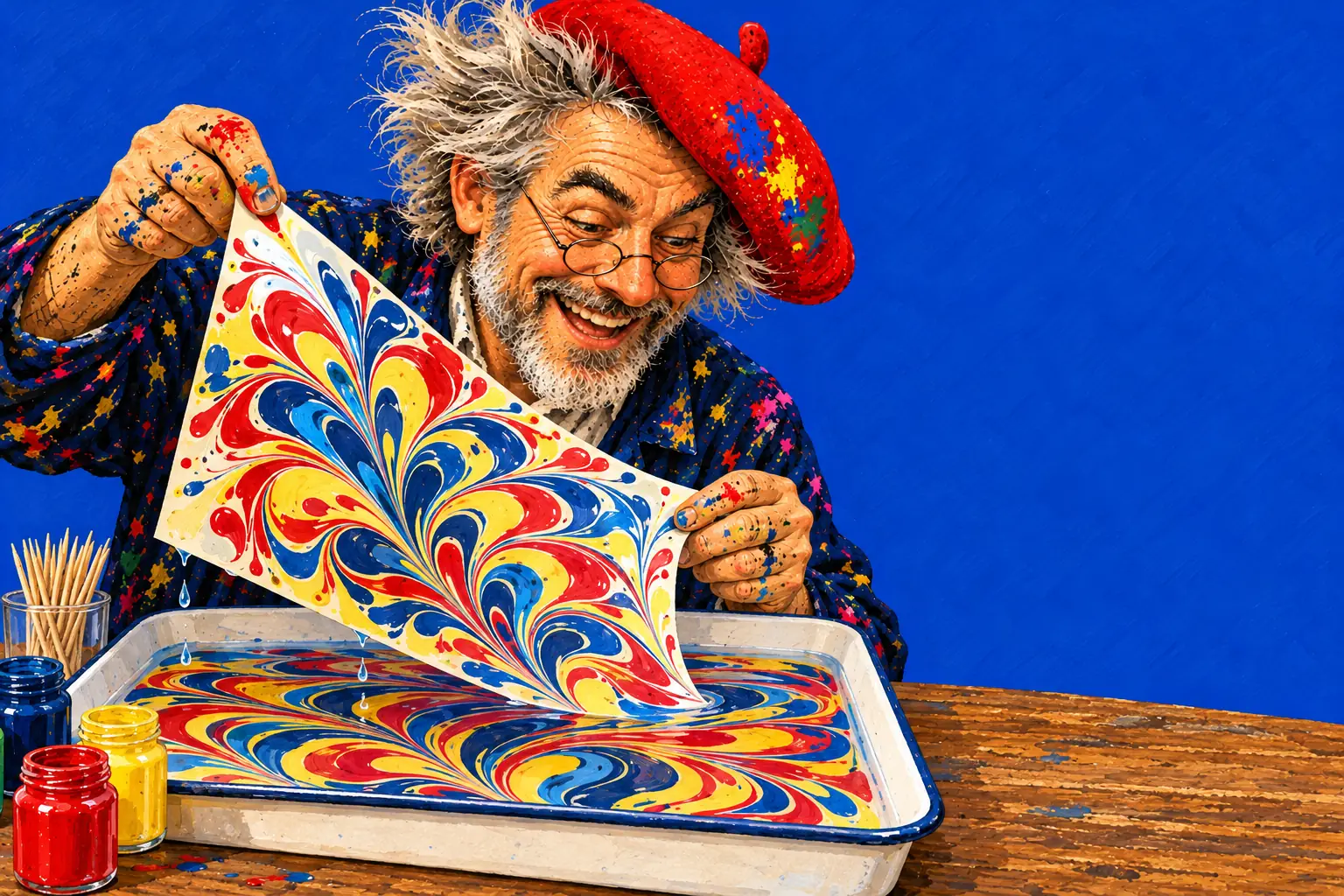
Float inks on water, swirl them and lift the pattern off with paper.
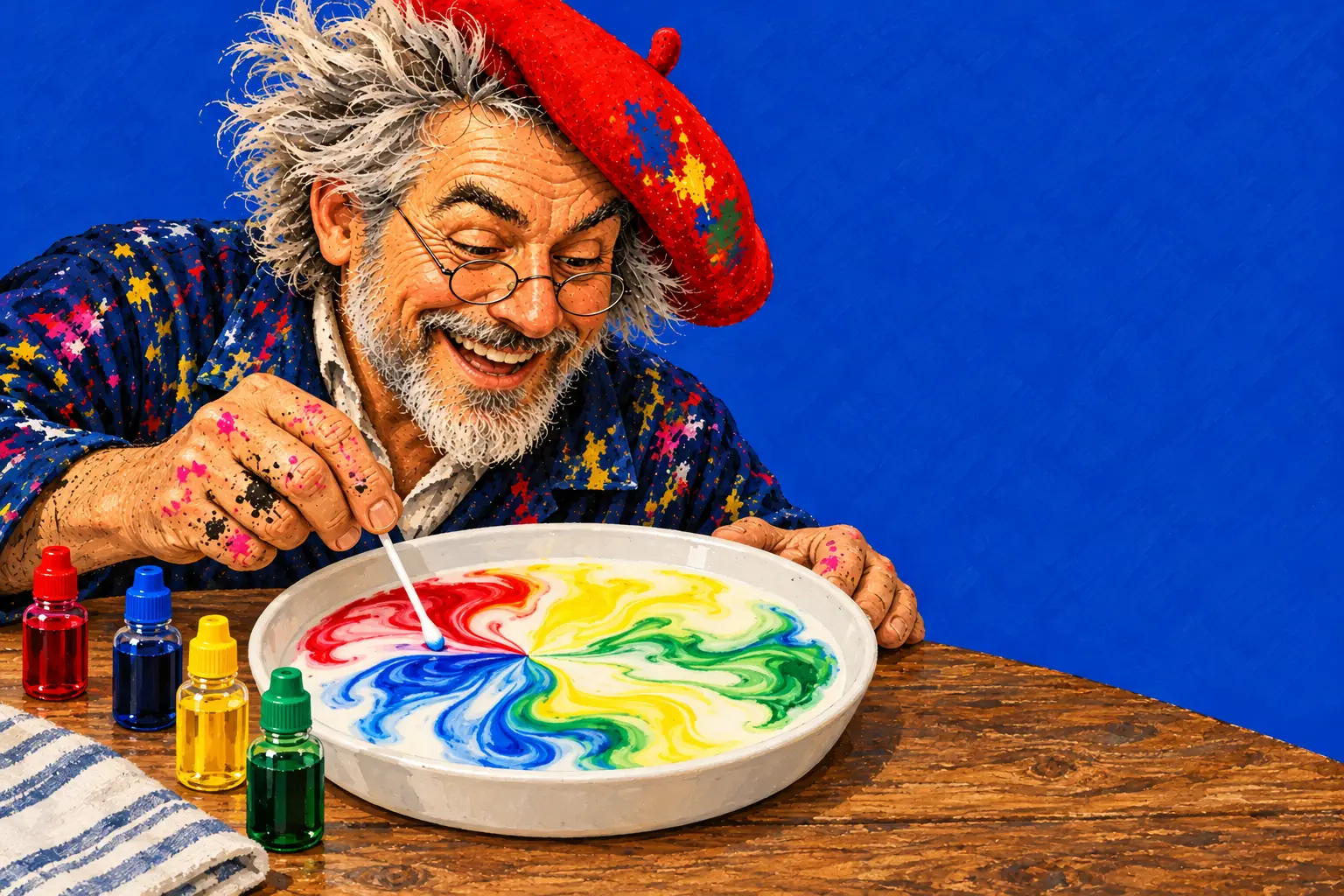
Soap breaks the surface of milk, and the colours rush away.
Why water on burning oil is dangerous, shown safely on screen.